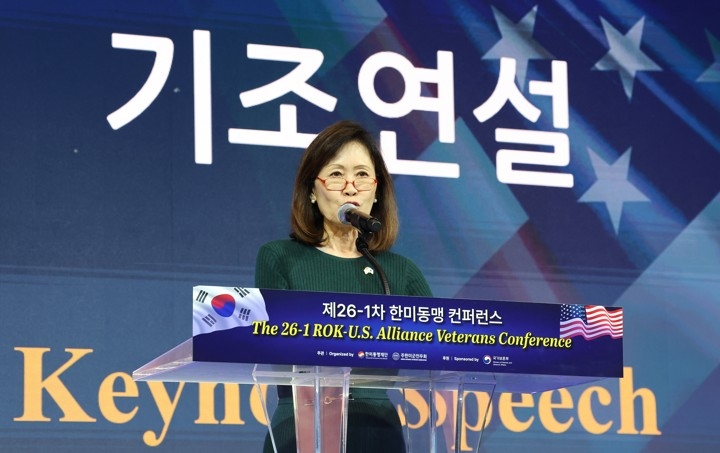
US Ambassador to South Korea Michelle Steel on Friday highlighted the South Korea-US alliance as the "linchpin" of peace and security on the Korean Peninsula and in the Indo-Pacific.
Steel made the remarks at a forum in Seoul, noting the bilateral alliance was forged over 70 years ago with blood and sacrifices made in the 1950-53 Korean War.
"For more than 70 years, the US-ROK alliance has been the linchpin of peace and security on the Korean Peninsula and throughout the Indo-Pacific," Steel said in her opening address, referring to South Korea by its official name, the Republic of Korea.
"Our mutual defense treaty is an unbreakable bond," she added. "But our alliance is more than an agreement between governments. It is also a human story. It is our story."
Steel stressed that Seoul and Washington share "one story" forged in war and secured by American and Korean soldiers who stood "shoulder to shoulder" to defend freedom during the Korean War.
Highlighting that South Korea has now become a "global leader" in a number of areas, including technology, culture, manufacturing and democracy, Steel said such an achievement was first and foremost attributable to the people of Korea, but also to the service members of the US and South Korean armed forces.
"To our active-duty service members from US Forces Korea (USFK) and the ROK armed forces, thank you for answering the call," she said. "You are the living expression of our ironclad alliance."
On the joint fact sheet adopted after last year's summit between President Lee Jae Myung and US President Donald Trump, Steel said the agreement showed the allies are working together for a "stronger, safer and more prosperous future."
"We are strengthening our security cooperation. We are modernizing the alliance. We are deepening trade and investment, and we are building on our cooperation in shipbuilding, technology and regional security," she said.
Eighth Army Commander Lt. Gen. Joseph Hilbert stressed that the South Korea-US alliance is not merely a security agreement restricted to the Korean Peninsula, but a "comprehensive global partnership" that is vital in a world of growing friction.
"But this alliance cannot be understood only as a security agreement isolated to the peninsula," he said in his keynote address. "Today it is a comprehensive global partnership."
Hilbert underscored the importance of deterrence in the face of multifaceted security challenges, including growing coordination among authoritarian states, such as North Korea, Russia and China.
"The DPRK remains a clear and immediate threat," he warned, noting that the North's military ambitions, weapons programs, cyber activities and growing external relationships cannot be viewed in isolation, but as problems with implications "above and beyond the peninsula."
"That is why deterrence here matters globally, and that is why our physical presence, our combined readiness and our demonstrated commitment matter so much," he added. DPRK is short for the Democratic People's Republic of Korea, North Korea's official name.
Hilbert also highlighted alliance modernization as "central" to attain the posture needed to achieve deterrence in South Korea.
"The purpose is not change for change's sake," he said. "The purpose is to ensure that this alliance is stronger, faster and more capable tomorrow than it is today."
The annual forum, hosted by the US Alliance Foundation and Korea Defense Veterans Association, was held under the theme, "The sacrifice of the US Forces Korea after the armistice agreement, and the South Korea-US alliance."
It was attended by Vice Veterans Minister Kang Yun-jin and former USFK commanders, including Paul LaCamera, Burwell Bell and Robert Abrams, as well as veterans of the Korean War. (Yonhap)